Ten months of political drift and scholarly skepticism in Venezuela are giving way to cautious reappraisal. The turning point has not been a diplomatic breakthrough or an institutional reform, but the high-stakes return of opposition figure María Corina Machado. Her arrival has galvanized a weary populace and effectively launched an unofficial presidential race, prompting even the most measured political analysts to consider whether a genuine democratic opening has finally arrived.
The Spark of a Homecoming
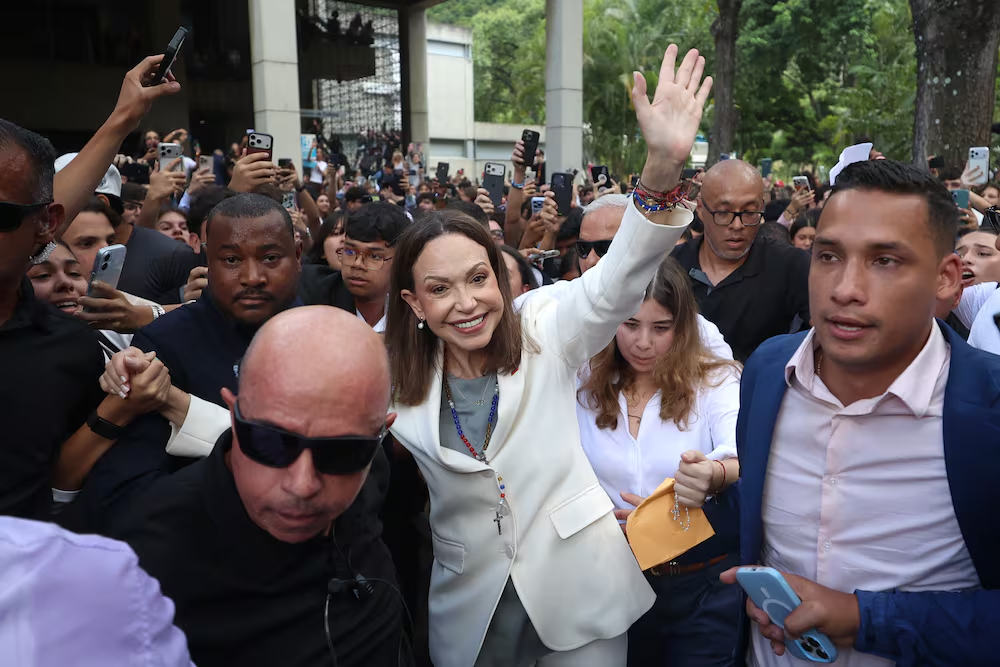
For months, the idea that Venezuela had entered a substantive transition was treated with suspicion. Historians and political scientists, notably Margarita López Maya, maintained that structural shifts remained absent. Following Machado’s reemergence in Caracas, however, the needle has moved. López Maya noted that the country is demonstrably closer to a transition because the political figure capable of unifying disparate opposition forces and steering them toward democratization is finally back on home soil.
Machado’s public reception was charged with raw emotion—supporters weeping, embracing her, and treating her presence almost as a deliverance. Public opinion data consistently confirms that, were transparent elections held immediately, Machado would capture a decisive victory. Her leadership has evolved from principled resistance into a potent, charismatic mass movement.
Yet the central obstacle remains unchanged: there is still no date on the electoral calendar.
The Constitutional Maneuver: Delay as Strategy
While Machado advocated for holding presidential elections by mid-2027 during an October 29 press briefing, other diplomatic and governmental timelines point to significant delays:
-
The State Department’s Timetable: Behind-the-scenes signals from Washington suggest a preference for a more extended timeline to stabilize negotiating frameworks.
-
The Regime’s Rhetoric: Acting President Delcy Rodríguez publicly pledged that future votes would strictly follow the Constitution—an ironic assurance given the prolonged dismantling of the country’s legal and institutional safeguards.
-
The “Absolute Absence” Loophole: Crucially, neither the United States as an intermediary nor the ruling leadership has formally triggered the constitutional clause acknowledging Nicolás Maduro’s permanent absence from office.
Under Venezuelan law, declaring an executive vacancy during the first three years of a presidential term requires organizing a snap election within 30 days. Pushing beyond that window allows the vice presidency to absorb the rest of the term. For Delcy and Jorge Rodríguez, running down the clock provides a viable route to retaining executive authority until 2030, bypassing a near-term electoral test that the ruling party cannot reliably win.
Pragmatism, Adaptability, and Entrenched Interests
Machado’s presence complicates the government’s timeline, but popular momentum alone does not guarantee a democratic handover. A clear-eyed view of Caracas reveals several systemic headwinds:
-
A Resilient Regime Apparatus: The governing establishment has largely shed ideological orthodoxies in favor of raw survival and pragmatic dealmaking, retaining substantial leverage over the economy, the security services, and informal revenue streams.
-
Entrenched Patronage Networks: Lucrative, opaque business relationships and corruption networks have deep incentives to preserve the status quo or derail any accountability measures.
-
Opposition Fragmentation: Despite widespread public rejection of the regime—with over 60% of citizens favoring a change in power—the opposition has historically suffered from strategic blind spots, infighting, and over-reliance on individual personalities.
-
Foreign Geopolitical Leverage: External backers, including Moscow, retain significant tactical interest in keeping the ruling coalition insulated from sudden shifts.
As opposition leaders like Carlos Valero have noted, desire for political alternation does not automatically yield results; democratic transitions carry no blueprint and depend on relentless tactical discipline. Furthermore, analysts warn that a heavily personalized movement risks producing sectarian divides that could undermine the broad-based coalitions necessary for institutional stability.
The Verdict
Machado’s return has undeniably reset Venezuela’s political atmosphere, replacing months of inertia with genuine momentum. Yet the path ahead demands far more than rallies and public devotion. Navigating the entrenched interests of the ruling elite, international diplomatic trade-offs, and constitutional manipulation will require exceptional strategic precision.
While skepticism remains well-warranted, Machado’s homecoming has delivered the single most compelling evidence in ten months that Venezuela’s transition might, at last, be shifting from theory into reality.