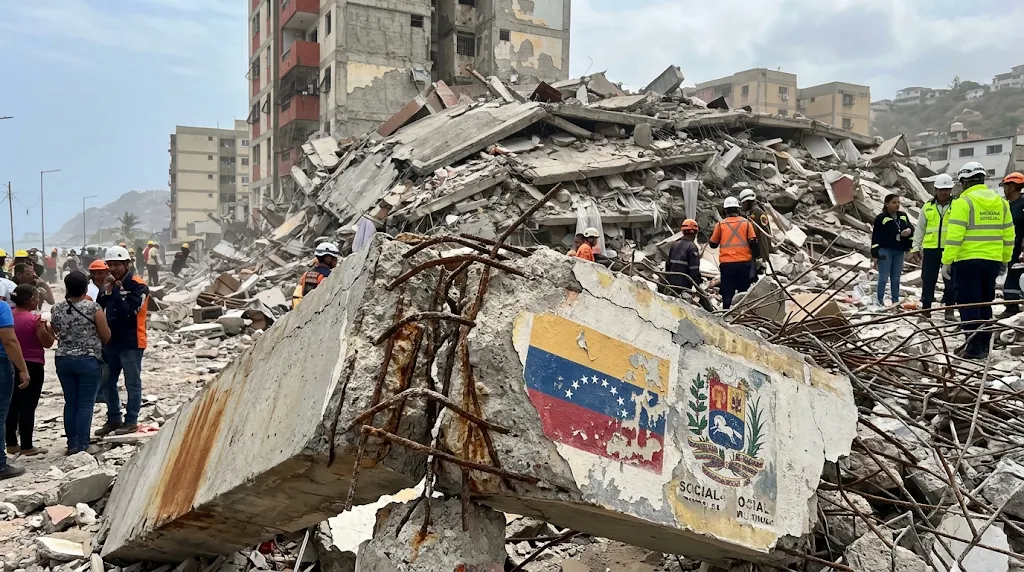
When massive twin earthquakes ripped through Venezuela’s northern coastline, Ailin Quiroz hurried toward the seaside town of Caraballeda desperate to find her sister. Instead, she arrived to find the high-rise public housing block reduced to a catastrophic mountain of pulverized concrete and tangled steel.
Her family’s tragedy was not an isolated act of nature. While the powerful quakes brought widespread destruction across the region, a forensic analysis and review of photographic evidence reveals that catastrophic construction shortcuts, severe material degradation, and ignored structural safety standards turned state-sponsored housing complexes into deadly traps.
Decaying Rebar and Compromised Concrete
An examination of more than 40 verified post-disaster photographs and site footage from collapsed complexes—specifically within the state-run OPPPE housing developments—points to deep structural vulnerabilities long before the ground shook:
-
Advanced Rebar Corrosion: Structural engineering analysts observed that roughly half of the collapsed public housing structures in the sector exhibited extensive rust and deterioration along their reinforcing steel rebar. While the coastal climate of Caraballeda accelerated oxidization, experts note that proper concrete cover and sealants should have protected load-bearing bars for decades.
-
Diluted Concrete Mixtures: Construction workers involved in the original erection of the public complexes admitted that building crews routinely stretched concrete supplies by blending unapproved filler materials and impurities into batches. The substandard mixes left the cured material porous, brittle, and vulnerable to moisture infiltration that steadily corroded internal metal supports.
-
Chronic Pre-Disaster Warning Signs: Residents had reported troubling signs for years. Neighbors reported that floors in complex towers would fissure from minor impacts, while in late 2025, an OPPPE resident reported to local media that his wife was injured after a heavy slab of their living room ceiling abruptly broke loose and collapsed onto her.
Critical Engineering Omissions
The investigation highlights that the failures extended far beyond poor-grade mortar:
-
Absence of Shear Walls: Independent seismic analyses identified an absence of visible shear walls—the reinforced vertical elements essential for absorbing lateral forces during tectonic shaking.
-
Column Orientation Deficiencies: Structural columns across several towers were oriented in uniform alignments rather than distributed configurations. This design severely diminished their resistance against multi-directional seismic shockwaves, causing ground-floor supports to shear rapidly under lateral stress.
-
Overlooked Site Hazard Assessments: Despite long-standing warnings from geological specialists regarding high-seismic vulnerability along the coastal fault corridor, state agencies pushed forward with dense, multi-story housing blocks without enforcing earthquake-resilient building codes.
The Toll of Impunity
The socialist government’s public housing campaign was once championed as a crowning social welfare achievement, providing hundreds of thousands of low-income Venezuelans with modern homes. Today, the ruins along the coastline serve as a grim monument to institutional corruption, deregulation, and corners cut in the name of speed and political optics.
As grieving families sift through the rubble searching for answers and missing relatives, the evidence shows that while nature dealt the blow, human negligence and systemic engineering failures dictated the scale of the catastrophe.