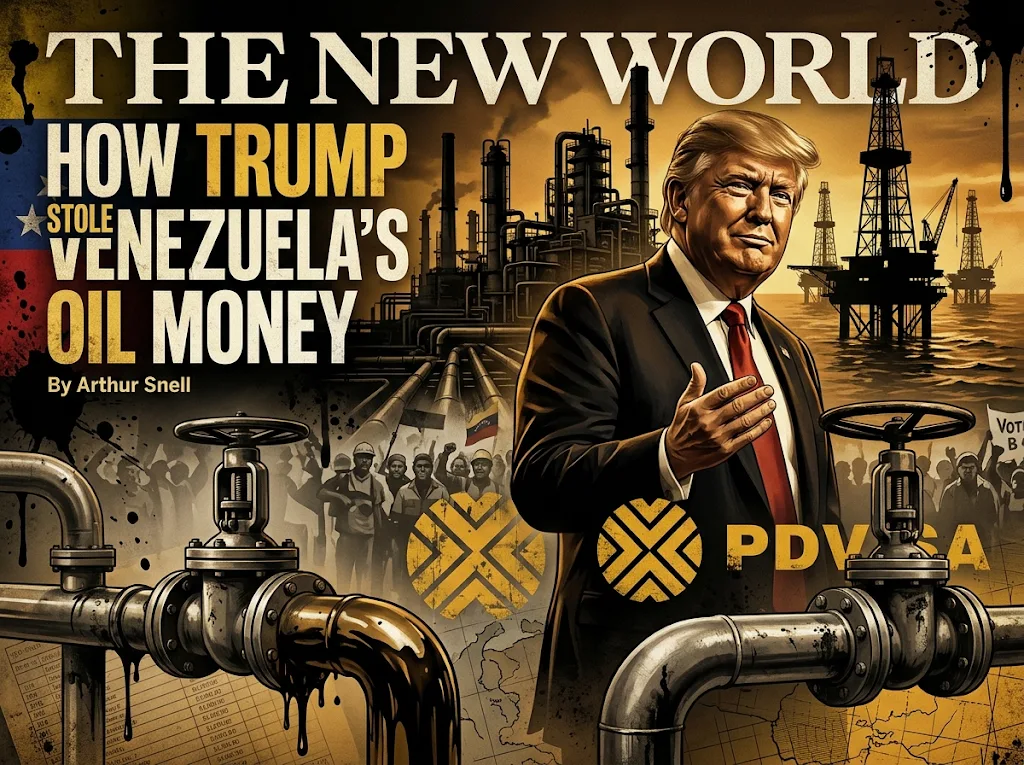
Following the decisive Democratic takeover of the U.S. House of Representatives in the recent midterms, incoming Oversight Committee Chair Robert Garcia offered a terse, two-word message to the White House: “LAWYER UP.” While official corruption has long cast a shadow over Washington, the impending congressional investigations are poised to scrutinize an unprecedented geopolitical scandal: the wholesale exploitation and financial plundering of Venezuela’s natural resources under Donald Trump.
Unlike traditional political controversies centered on campaign finance abuse, the White House’s policy toward Caracas represents naked commercial self-enrichment and state-level patronage.
“To the Victor Belong the Spoils”
Following the U.S. military raid that captured former Venezuelan President Nicolás Maduro, Trump bluntly summarized the new reality on the ground: “We’re in charge.”
Despite years of fierce anti-Marxist rhetoric, the administration quickly endorsed regime apparatchik Delcy Rodríguez as interim president. Rather than ushering in genuine democratic reform, the arrangement preserved the state’s authoritarian machinery—complete with arbitrary detentions and suspended elections—with one critical change: the Venezuelan economy was effectively reconfigured to serve the financial and strategic interests of Donald Trump and his inner circle.
Sitting on an estimated $20 trillion in proven petroleum reserves alongside vast deposits of gold and gemstones, a weakened and isolated Venezuela presented an irresistible target for extraction.
Controlling the Tap: Billions in Shadow Accounts
Since early 2026, the United States has maintained direct operational control over Venezuela’s petroleum exports. As Trump declared early on, “That money will be controlled by me.”
The mechanisms established to manage these vast revenues have largely operated outside congressional oversight:
-
Opaque Gulf Accounts: The U.S. Treasury diverted crude sales proceeds into specialized accounts in Qatar, consistently refusing to disclose ledger details to lawmakers. (The arrangement coincided with Qatar providing Trump a $400 million luxury jet).
-
Missing Revenues: By July 2026, the Financial Times calculated that the U.S. government had taken control of at least $13 billion in Venezuelan crude revenue. While Secretary of State Marco Rubio asserted the funds were earmarked for Venezuelan civil servants, actual allocations remain opaque and dictated exclusively by Washington.
-
Extortionate Contracts: Touting the “biggest oil deal in world history,” the administration secured terms allowing the Pentagon to take an equity stake in a major Venezuelan energy enterprise—backed by a guarantee granting the U.S. government 20% of future output at an artificial floor of just $30 per barrel, well below global market value.
The Corporate Feeding Frenzy
The subjugation of Venezuela’s sovereign wealth quickly opened the floodgates for prominent figures and enterprises across the MAGA orbit:
-
Upstream Oil Rights: Harold Hamm’s Continental Resources finalized production contracts in the Orinoco Belt in partnership with state-controlled entities.
-
Gold and Minerals: Heeney Capital, included on official Trump administration trade delegations, secured sweeping concession rights across Venezuela’s lucrative mining sector.
-
Financial Gatekeeping: While sanctions locked Venezuela out of the Western banking architecture, Erebor—a newly formed financial institution backed by billionaire Peter Thiel and run by close associates—was granted Treasury clearance to process Venezuelan cross-border capital flows.
-
Trump-Aligned Shells: Rockville, an obscure investment vehicle headed by the CEO of Trump’s Truth Social corporate parent, began scouting and acquiring domestic assets.
-
Pardons and Influence: Former Trump attorney Alina Habba reportedly received a $50 million payout from a Venezuelan billionaire seeking executive clemency, while her husband expanded extensive commercial interests in Venezuela’s domestic cement industry.
Why True Democracy Threatens the Deal
The flourishing of this extraction apparatus relies entirely on keeping Venezuela in a legal twilight zone. A legitimate, democratic transition—led by an accountable government capable of auditing state resources and prosecuting corruption—would bring immediate scrutiny to these opaque contracts and revenue flows.
When Trump dismissed upcoming elections by claiming Venezuelans “just aren’t ready yet,” he ignored the fact that millions bravely voted against authoritarian rule in 2024. For the White House, political uncertainty is a deliberate feature, not an unintended consequence.
With control of the House slipping from Trump’s grasp, congressional subcommittees are preparing to subpoena records concerning the billions diverted into offshore accounts. The facade of Venezuelan “liberation” is crumbling, revealing a systematic campaign of state-backed economic plunder.